
Challenging Narratives of a Cultural Desert
A study of BIPOC arts and culture organizations in the U.S. Southwest
This brief illustrates the importance of safeguarding the legacies of arts organizations rooted in communities of color
September 2026
2 Min Read
Table of Contents
Overview
More
Less
Overview
More
Less
Ideas In Practice
Document
- Publisher(s)
- The Wallace Foundation
Page Count
2 pages
Summary
How we did this
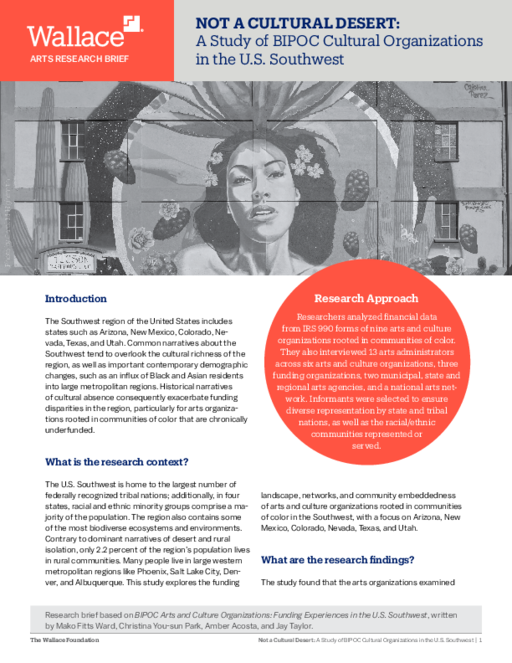
The research team analyzed financial data from IRS 990 forms of nine Black, Indigenous, and other People of Color (BIPOC) arts and culture organizations rooted in communities of color, with a focus on Arizona, New Mexico, Colorado, Nevada, Texas, and Utah. They also conducted in-depth interviews with 13 arts administrators across six arts and culture organizations, three funding organizations, two municipal, state and regional arts agencies, and a national arts network. These informants were selected to ensure diverse representation by state and tribal nations, as well as the racial/ethnic communities represented or served.
The U.S. Southwest is home to the largest number of federally recognized tribal nations; in four states, racial and ethnic minority groups comprise a majority of the population. The region also contains some of the most biodiverse ecosystems and environments. Contrary to dominant narratives of desert and rural isolation, only 2.2 percent of the region’s population lives in rural communities. Researchers at Arizona State University examined the funding landscape, networks, and the importance of embedded arts and culture organizations rooted in communities of color in the Southwest.
The study identifies the ways in which the organizations examined rely heavily on informal, community-based networks for mutual support, resource sharing, coalition building, and social accountability. They also documented the range of challenges faced by smaller arts organizations within this region.
The work points to the need for future research that builds a regional understanding of the U.S. Southwest, which is important for local arts organizations and funders. It also uplifts other ways that funders and other stakeholders can take a more equitable approach to supporting organizations in this region.
This brief is based on BIPOC Arts and Culture Organizations: Funding Experiences in the U.S. Southwest, written by Mako Fitts Ward, Christina You-sun Park, Amber Acosta, and Jay Taylor from Arizona State University.

Organizations within these networks serve as cultural hubs, especially within predominantly white spaces, for nurturing and expressing identity, amplifying underrepresented voices, and advocating for cultural and social policies.
Topics:
Now Viewing:
Overview
Next: Ideas In Practice