
Download the Brief
This brief summarizes key research findings on how principals influence student achievement, teacher retention, school climate, and other key outcomes.
The Principal Effect
How Investing in School Leaders Is Key to Solving Today’s Major K-12 Challenges
This report shows how principals are essential to addressing critical issues, such as teacher retention and student absenteeism.
May 2026

Table of Contents
Document

- Author(s)
- Linda Darling-Hammond, Julie Fitz, Maria Giani, Molly Gordon, and Marjorie E. Wechsler
- Publisher(s)
- The Learning Policy Institute
Page Count
28 pages
- DOI Link
- https://doi.org/10.54300/644.197
WHO IS THE WALLACE FOUNDATION?
We are an independent research foundation helping communities build a more vibrant and just future. We work in the arts, education, and youth development sectors. With our partners and grantees, we seek to solve problems and improve people's lives. The evidence-based research we share supports policymakers and practitioners working to enhance community vitality and help all people reach their full potential. Learn more about our focus areas.
Summary
How we did this
The authors reviewed and summarized existing research on the role principals play in school improvement, including addressing teaching quality and school climate to boost student engagement and learning. They also describe what’s known from reputable studies that probe how strengthening principal effectiveness and retention can lead to positive outcomes, with special attention to policy implications at the federal, state, and local levels.
Efforts to improve public schools today tend to focus on particular challenges such as student achievement, chronic absenteeism, or teacher retention. But this fragmented approach often neglects a central, high-leverage factor: the school principal.
An effective principal can influence the experiences of teachers, staff, students, and everyone on campus. Moreover, research shows that investing in strong school leaders is one of the most effective ways to improve student outcomes, strengthen the educator workforce, and advance equity.
This report draws on decades of research to explain how principals play a key role in improving schools and how policymakers can invest in developing and supporting strong leaders. It particularly references the 2021 synthesis report How Principals Affect Students and Schools, which affirmed that principals have a pronounced positive effect on the schools they lead.
How do principals support education outcomes?
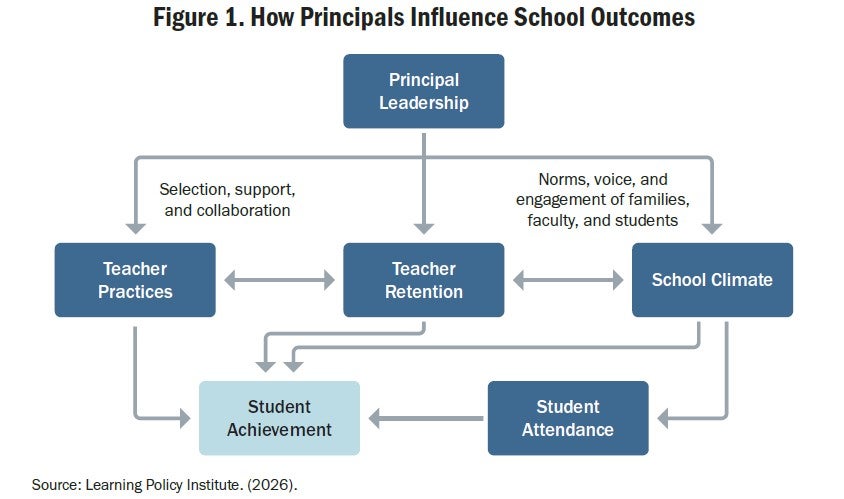
Principals affect student and teacher outcomes in three key ways:
- Supporting effective instruction
- Retaining teachers, which strengthens school stability and expertise
- Creating a positive school climate that welcomes and connects staff, students, and families
Effective principals can also have a more pronounced impact in schools with a sizable share of students from historically underserved communities. Put simply, strengthening and investing in school leadership is a powerful equity strategy.
The benefits for students come primarily through principals’ support for teachers and their practices. Those touch points include:
- Orchestrating strong teacher professional development
- Making strategic teacher assignments
- Providing ample opportunity for teacher collaboration
- Promoting a professional culture
- Delivering improvement-focused feedback to educators
In addition, effective principals retain teachers over time, which improves school stability and student outcomes.
The report also outlines some of the ways that district, state, and federal policymakers can employ evidence-based strategies to improve school quality and achieve greater equity in schools. Policymakers can find a list of these strategies in the Implementation Tips section of this report page.

Developing and supporting strong principals is a critical approach to strengthening schools and tackling many of the problems currently addressed in a piecemeal fashion.
Key Takeaways
- School improvement strategies are often fragmented and neglect the one role at the center of everything on campus: the principal.
- Principals affect student, teacher, and staff outcomes in three key ways: 1) supporting effective instruction, 2) retaining teachers, and 3) creating a positive school climate.
- Strengthening and investing in school leadership is also an equity strategy, given that effective principals have even larger effects in schools serving historically underserved communities.
- Successfully preparing and supporting principals is one of the best investments state and district-level policymakers can make to improve schools.
- Principal effectiveness and stability are products not just of individual skill, but of systemic support and strong policy designs, and there are several evidence-based strategies policymakers can use to create these conditions.
Visualizations
Materials and Downloads
You May Also Like

Assistant Principals: Growth and Implications for School Leadership
This report documents the proliferation of assistant principals in public schools–where they work, what they do, and what additional support they need.
Report

How Districts Can Build Principal Pipelines That Last
Four research-backed ways districts can sustain their principal pipelines.
Report

Principal Supervision Is Not a Solo Act
Why school leaders need more than a single line of support.
Report
Topics:
Now Viewing:
Overview
Next: Implementation Tips